Our research · E-commerce in Turkiye
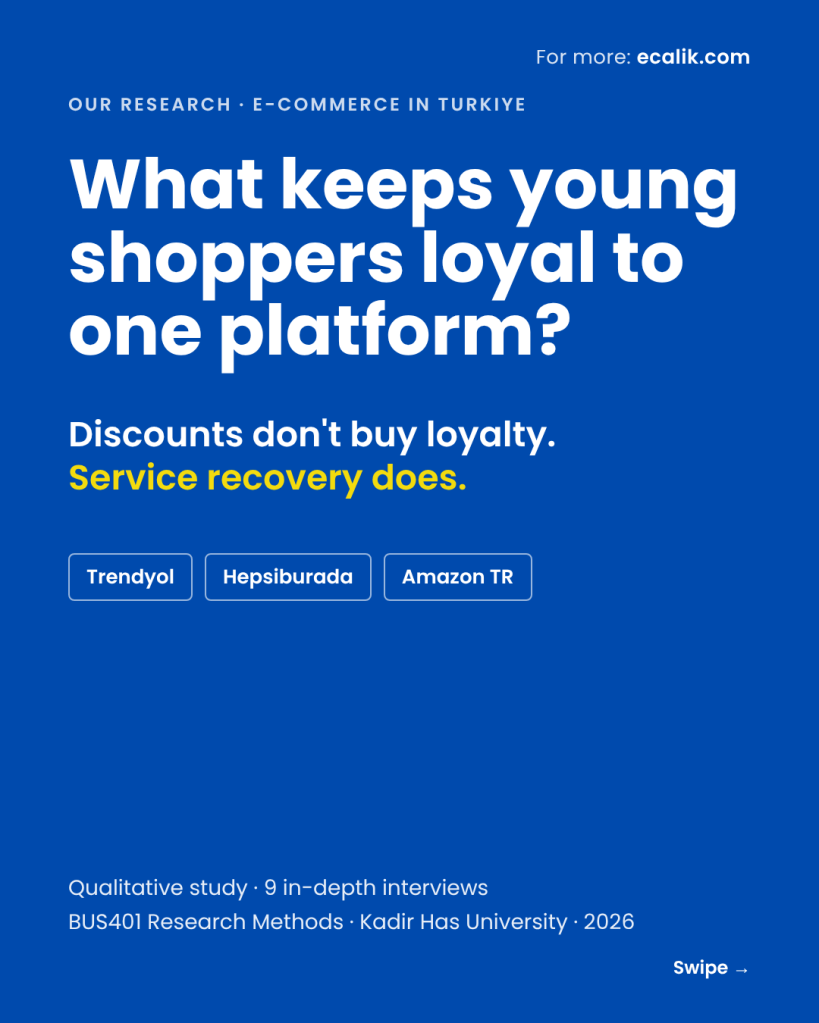
Discounts don’t buy loyalty. Service recovery does.
Why do young Turkish consumers choose, stay with or leave an e-commerce platform? A qualitative study of Trendyol, Hepsiburada and Amazon TR users, from research design to recommendations for platform managers.
BUS401 Research Methods · Kadir Has University · Fall 2026 · Qualitative, 9 in-depth interviews
Swipe for all six slides →
The short answer
Loyalty is built on habit, guarantees and recovery. Fast, free delivery and price matter to nearly everyone, so they don’t separate one platform from another. What does is which app a shopper opens first out of habit, which platform they trust for a given category, and how the platform behaves when an order goes wrong.
For a platform, that shifts the question from “how big is the next discount?” to “what do we guarantee, and what do we do after a failure?”
Why this question
E-commerce in Turkiye reached ₺4.6 trillion in 2025, a 19.3% share of total trade (T.C. Ticaret Bakanlığı, 2026). Inside that market, loyalty is the hard part:
- A few large platforms dominate. Trendyol, Hepsiburada and Amazon TR sell largely the same products, often from the same sellers.
- Prices and offers look alike. Sale days, free-shipping thresholds and memberships (Plus, Premium, Prime) are copied quickly.
- Switching costs almost nothing. Young shoppers keep several apps on their phone and compare in seconds.
So platforms need to know what builds loyalty beyond discounts. We did not know how young consumers themselves explain their platform choice, how they weigh trust against price and convenience, and which experiences make them switch.
Four research question themes
- Choice. Which factors do young consumers name as decisive when choosing a platform: price, delivery speed, returns, assortment, campaigns, app experience?
- Trust. How do consumers build and lose trust in a platform and its third-party sellers?
- Experience and loyalty. How do negative experiences such as late delivery, fake or wrong products and return problems affect loyalty and switching?
- Personality. How do consumers perceive the “personality” of Trendyol, Hepsiburada and Amazon TR?
Four concepts from the literature shaped the questions: e-trust (Gefen, 2000; Pavlou, 2003), e-service quality (Parasuraman, Zeithaml & Malhotra, 2005), customer loyalty (Oliver, 1999) and brand personality (Aaker, 1997). They were used as sensitising concepts for the discussion guide, not as hypotheses to test.
How we did it
Design
An exploratory, qualitative design: the aim was depth and meaning, not frequencies or generalisation. We chose semi-structured in-depth interviews because trust and loyalty are personal, experience-based topics that need probing, and a one-to-one setting avoids the group pressure of a focus group.
- Sampling: non-probability, purposive choice from our own networks, varied by main platform.
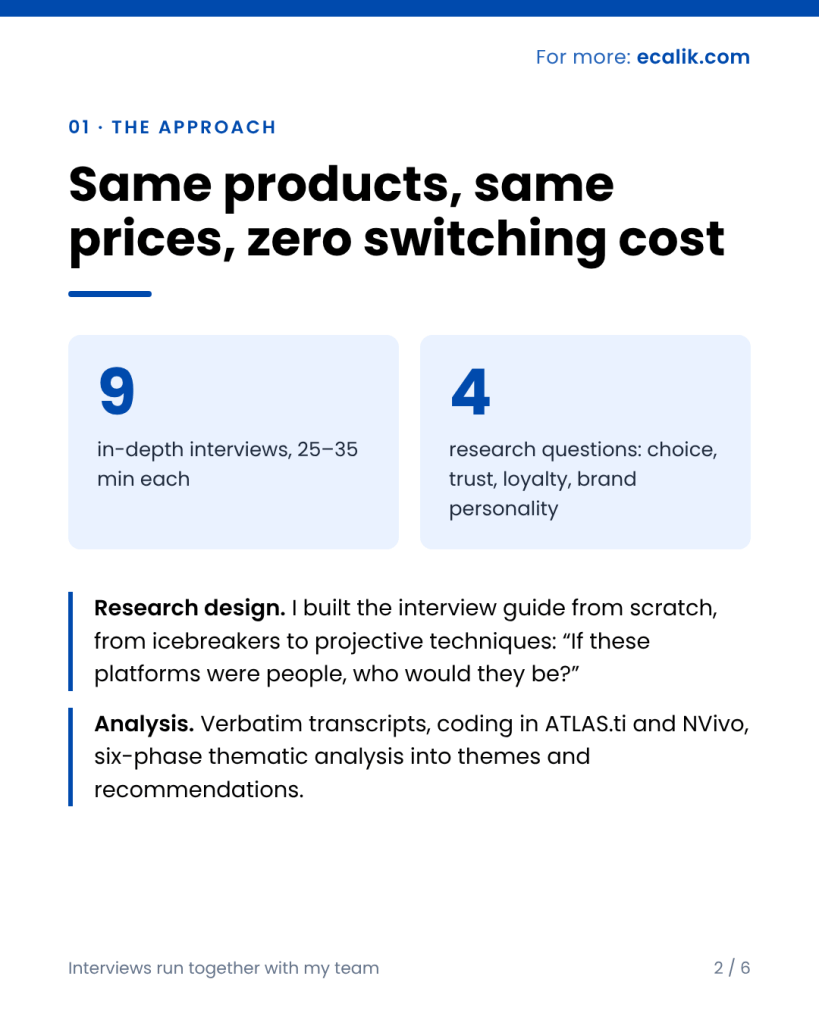
- Size: 9 interviews of 25–35 minutes each, in Turkish or English, face-to-face or on Zoom.
- Inclusion: aged 18–30, living in Turkiye, at least three online purchases in the last six months, and experience with at least two of the three platforms.
- Ethics: verbal consent, voluntary participation, anonymous P-codes.
Discussion guide
18 open-ended main questions with sub-questions and neutral probes, ordered from broad to specific with the key question saved for last:
- Welcome and consent
- Broad icebreaker: “How does shopping fit into your daily life?”
- Increasingly specific topics: “Imagine you need new headphones today. Walk me through what you would do.”
- Projective techniques: “If these three platforms were people, what would each be like?”
- Key objective: “Have you ever stopped using a platform? What was the turning point?”
- Closing: “If you could give one piece of advice to these platforms’ managers…”
Projective techniques
People find it hard to say directly what they feel about a brand, so the guide used four projective techniques:
- Word association: the first words that come to mind for each platform.
- Sentence completion: “People who shop on Trendyol are…”
- Cartoon test: a friend says “My order came late again, and it was the wrong size.” What does the other friend answer?
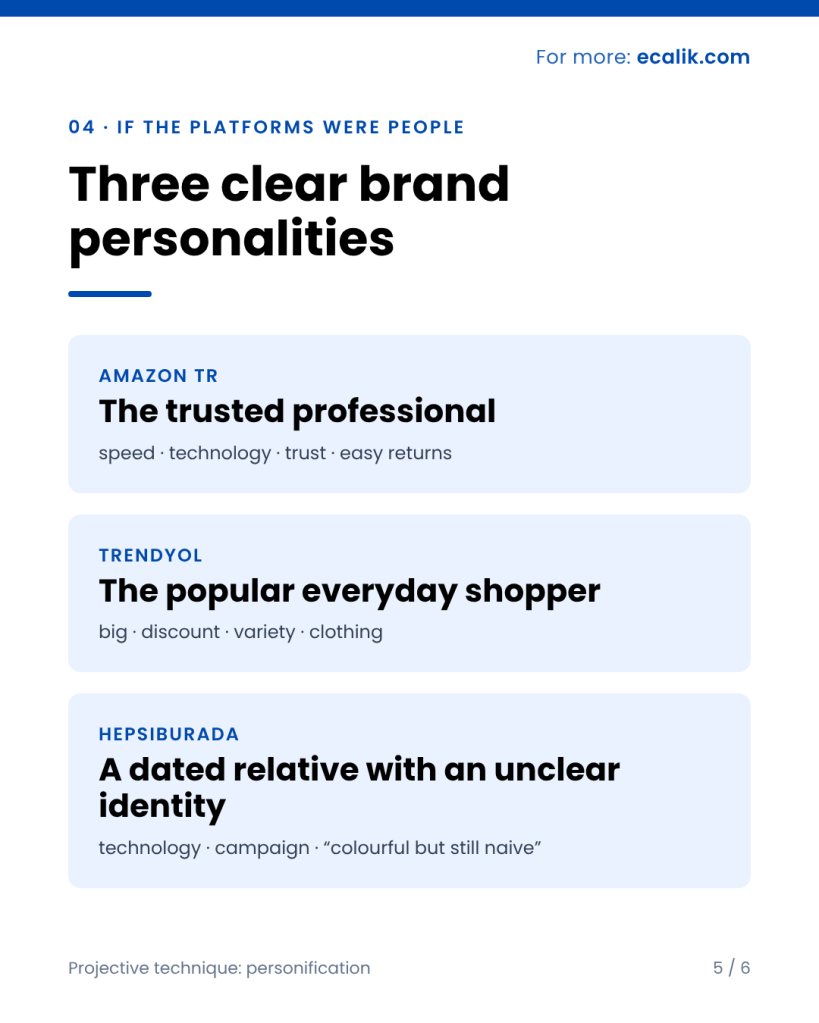
- Personification: if these platforms were people, how old would they be, what job would they have, and which would be your friend?
Analysis
Six-phase thematic analysis after Braun & Clarke (2006): familiarise, generate initial codes, search for themes, review themes, define and name them, report. The workflow ran from audio recordings to verbatim transcripts (names replaced by P1–P9), a starting code frame, coding in ATLAS.ti Web and a cross-check in NVivo 15 through a REFI-QDA project.
- ATLAS.ti shows presence: 9 documents, 19 codes and 109 codings, with each code applied once per interview to the clearest answer.
- NVivo shows frequency: 484 coding references across the same 19 codes, showing how much talk each topic took up.
- Trustworthiness: codes and themes reviewed by the whole team, every theme backed by verbatim quotes, and an audit trail of code changes (Lincoln & Guba, 1985).
My role
- Designed the research and the full bilingual interview guide, from icebreakers to projective techniques (“If these platforms were people, who would they be?”)
- Led the analysis of 9 semi-structured in-depth interviews run with a five-person student team: verbatim transcripts, coding in ATLAS.ti and NVivo, six-phase thematic analysis (Braun & Clarke, 2006) into themes and recommendations
What we found
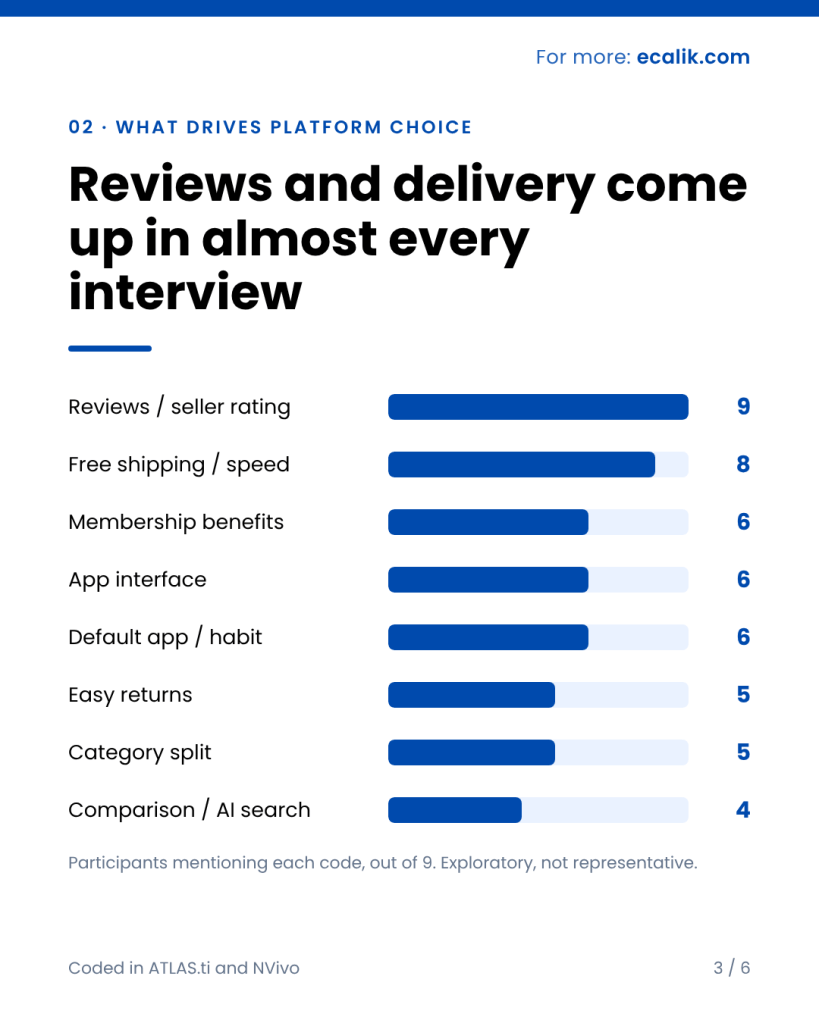
1. Everyone weighs delivery and price; habit picks the app
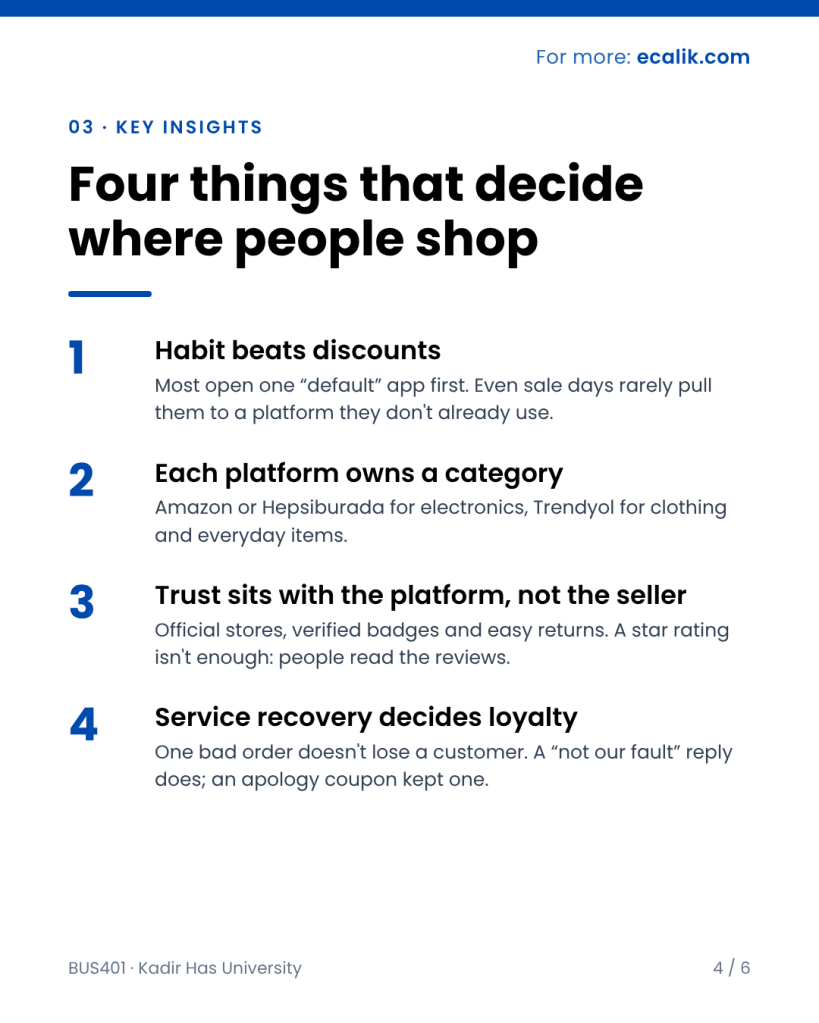
- A default app comes first. Most users open one “default” app first, often the one friends recommend; even sale days rarely pull them to a platform they don’t already use.
- Each platform owns a category. Amazon or Hepsiburada for electronics, Trendyol for clothing and everyday items.
- Free shipping, speed and memberships tip the balance. They decide between otherwise equal offers; Prime, Plus and Premium act as tie-breakers.
- An emerging habit: researching on ChatGPT or YouTube before buying.
2. Trust sits with the platform, not the seller
- Trust rests on the platform’s guarantees: its own retail account, official brand stores, verified-seller badges and easy returns.
- A star rating isn’t enough. Reviews are read, not just scored, and many ratings beat a few.
- Distrust often comes from other people’s stories rather than from a shopper’s own experience, so reputations spread by word of mouth.
- A few pay with virtual cards “to be safe”.
3. Service recovery decides loyalty
- One bad experience can end a secondary platform, but not a favourite.
- One bad order doesn’t lose a customer; a “not our fault” reply does. An apology coupon kept one, while silence or refusals ended relationships.
- Switching follows better service, for example easier returns or an app that fixed the same problem.
4. If the platforms were people
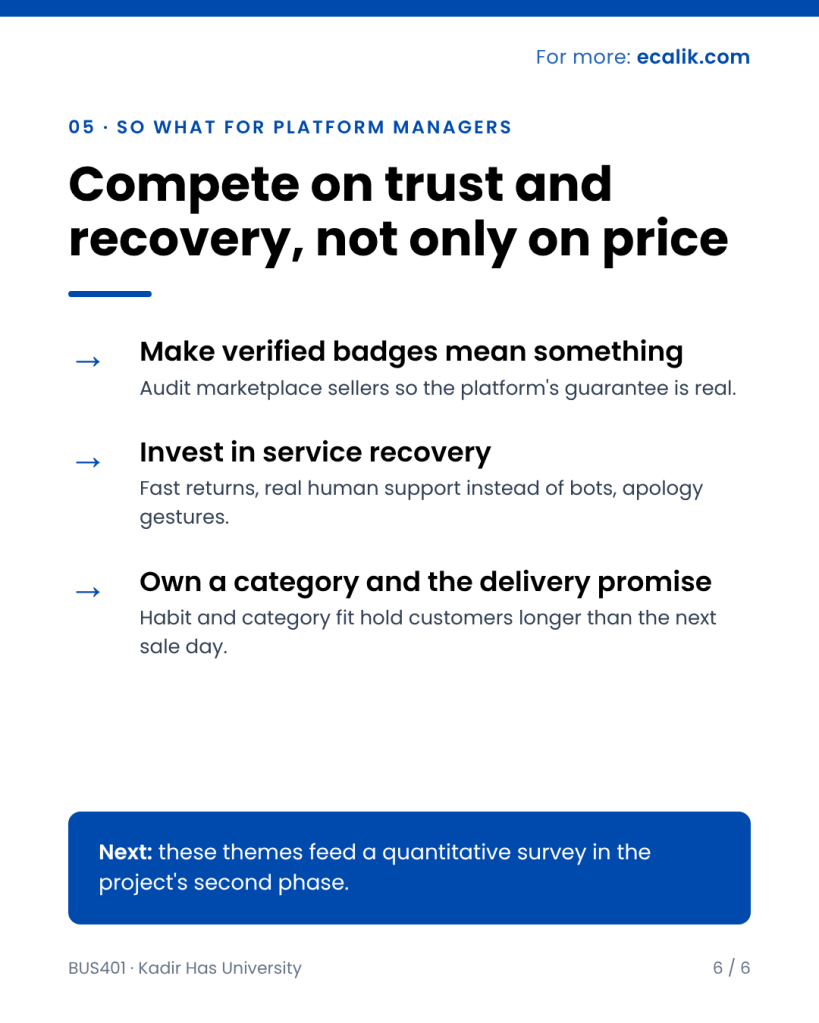
So what for platform managers
Compete on trust and recovery, not only on price.
- Make verified badges mean something. Audit marketplace sellers so the platform’s guarantee is real.
- Invest in service recovery. Fast returns, real human support instead of only bots, and apology gestures such as coupons.
- Own a category and the delivery promise. Habit and category fit hold customers longer than the next sale day.
- Keep the basics reliable. Dependable cargo and stable servers on sale days, plus support and couriers in English for international customers.
By platform: Hepsiburada should refresh its interface and own clear categories. Trendyol should simplify its busy interface. Amazon TR should add local sellers and clothing.
Limits and next step
- Small purposive, convenience-based sample (n = 9), recruited from our own networks.
- Ages 18–30 only, mostly in Istanbul.
- Self-reported, not observed, behaviour.
- The findings are not generalisable. The themes feed a quantitative survey in the project’s second phase.
Methods & tools
Files
Participants are anonymised (P1–P9). Interview recordings and transcripts are not shared, in line with Turkish data protection law (KVKK). Exploratory study with a small convenience sample; findings are not representative.
Strategy, process excellence and digital transition. · Türkçe oku

